ADHD planners, home resets, and no-shame restarts
A system you can reopen after a bad week.
Start anywhere. Skip days. Come back without explaining yourself. The pages are still there and they still work.
Written for adults with ADHD who have started over more than once.

Nothing here counts a streak. Missed days don't erase done days.
How much have you got today?
Not how much you should have. How much is actually there. Pick one and you'll get a single next step sized to it.
Your next five minutes
Clear one surface. The one you look at most.
Not the worst surface — the most visible one. Seeing the difference from the doorway is what makes the next five minutes possible.
Or sort by what today feels like: can't start, can't settle, foggy and slow, knocked sideways, everything at once, or see all. Not sure?
Take the free 2-minute quiz instead — self-reflection, not a diagnosis.
Free starter guide
The Brain Dump, and one week of the system.
A two-page brain dump you can print tonight, plus seven days of the No More Piles. structure so you can find out whether this way of working fits you before you buy anything.
- Brain dump & task breakdown pages — clear the mental clutter first
- One undated weekly page: three daily priorities, one zone, one energy check
- A 5-minute emergency reset you can use today
Send me the guide
Blame first, then one useful next step.
Most planners quietly assume the problem is that you didn't try hard enough. These start somewhere else: the mess is information, not a verdict. Then they hand you the smallest thing that actually moves it.
No streaks to break. No perfect-morning routine to fail at. No page that gets harder to open the longer you've been away from it. That's the whole design brief, and everything in the books is checked against it.
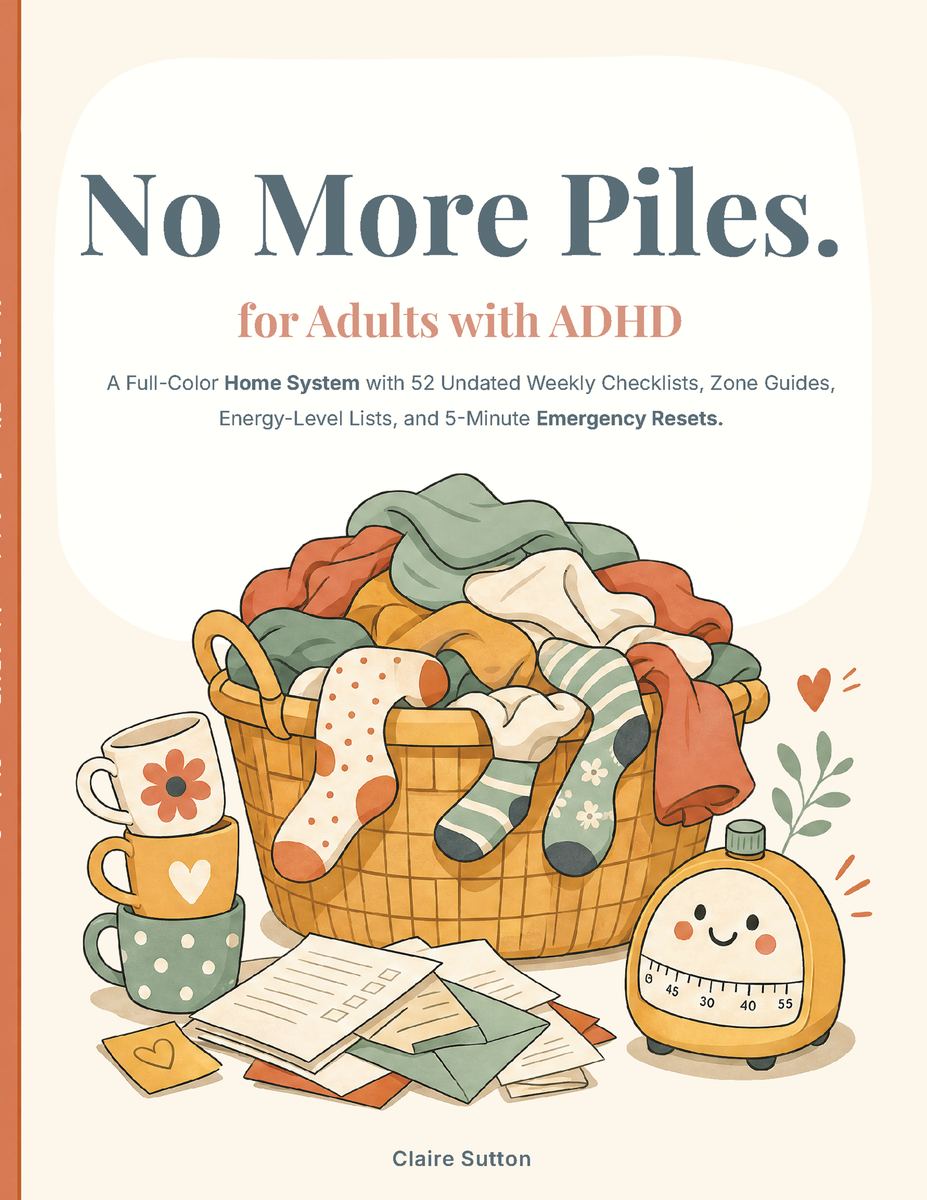
No More Piles. for Adults with ADHD
Your brain isn't broken. Your cleaning system is. A full-colour home system built for the days it goes wrong, not the days it goes well.
- 52 undated weekly checklistsThree priorities a day, one zone, one energy check.
- 7 room-by-room zone guidesQuick, standard, and deep tiers for every room.
- Energy-level cleaning listsLow, medium, or high — chosen on the day.
- Emergency reset pages5, 10, 20, and 30-minute versions.
- 30-day habit trackerMissed days don't erase done days.
- Brain dump pagesPark the mental clutter before you start.
More planners, cleaning systems, and narrative guides on the Claire Sutton author page.
Worth being honest about.
This works if
- You've bought beautiful planners that collapsed by week two.
- You need something that works when your brain won't cooperate.
- You want the mess named without being made into the mess.
- You'd rather restart on page 14 than start over at page one.
- You want a next step sized to how much you've actually got today.
This isn't for you if
- You want streaks, scores, and a system that notices when you stop.
- You need medical advice or a diagnosis, not a planner.
- You want the same plan no matter how much energy you've got.
- You want one perfect routine to follow forever.
- You don't want to edit or skip pages, ever.
A note from Claire Sutton

I don't write perfect systems. I write the ones that survive being ignored for three weeks — because that's the part every other planner leaves out, and it's the part that decides whether you keep going.
Claire Sutton, ADHD planner & workbook author
Your questions, answered.
What is the best ADHD planner for adults?
The one you can reopen after skipping it. In practice that means undated pages, very few decisions per page, and no streak counter — a dated planner with a broken streak becomes evidence against you, and most people never open it again.
How do I clean my house when I have ADHD?
Pick the smallest visible surface, set a timer, and stop when it rings whether you're finished or not. Finishing isn't the goal on a hard day; starting is. The stopping rule is what makes starting cheap enough to do again tomorrow.
What is an ADHD home reset?
A short, bounded pass through one space — five to thirty minutes — that puts things roughly where they belong. It isn't a deep clean and it isn't meant to be. It's a way to get the room back to a state where you can function in it.
Do ADHD cleaning systems actually work?
They tend to work better when they're designed around inconsistency instead of assuming it away — smaller units of work, no penalty for gaps, and a clear entry point on a low day. That's an organisational design choice, not a clinical claim.
Can people with ADHD follow a cleaning schedule?
Yes, when the schedule survives being skipped. A rota that expects every day to happen breaks permanently on the first missed one. A rota built on rotation and zones just picks up wherever you left it.
What makes a planner ADHD-friendly?
Fewer decisions per page, undated layouts, visible progress, an obvious smallest next action, and a way back in after a gap. If a page requires you to remember what you were doing three weeks ago before you can use it, it isn't one.
What is "ADHD paralysis" and how do I get unstuck?
It's a term people in the ADHD community use for being unable to start despite wanting to and knowing how. It isn't a clinical diagnosis. What usually helps is making the first action smaller than feels reasonable — one drawer, one email, two minutes — because the barrier is at the start, not in the middle.
What is "ADHD burnout"?
It's a community term, not a formal diagnosis, and there's no agreed clinical definition of it specific to ADHD. People generally use it for the exhaustion that follows a long stretch of compensating and pushing through. If what you're experiencing is persistent or affecting your health, that's worth raising with a qualified provider rather than solving with a planner.
Start anywhere. Today counts.
Take the free guide, use one page, and come back when you want the rest. Nothing here expires and nothing here keeps score.
Get the free starter guide